

Sex & Intimacy
in Relationships
You love each other. But you don't feel like lovers anymore.
Couples therapy for rebuilding emotional and sexual connection.
Somewhere along the way, something shifted.
Maybe you're still affectionate. You still say “I love you.” You manage the house, raise the kids, make plans, and get through life together.
But sex happens less often — or not at all. One of you initiates while the other pulls away. Touch that once felt natural now carries pressure. Maybe you feel unwanted, rejected, overwhelmed, or unsure how to even begin anymore.
You may be great teammates, good friends, devoted parents...
but you miss feeling like a couple.
What's Happening Between You Shows Up in Bed.
Sexual disconnection rarely happens in a vacuum.
Sometimes one partner needs to feel emotionally connected before sexual desire can emerge. For the other, physical intimacy may be one of the ways they feel emotionally connected.
One reaches for closeness and feels rejected.
The other experiences pressure and pulls away.
Over time, even ordinary affection can start to feel complicated. A hug might carry an unspoken question: Is this going to lead to sex? Initiating can feel risky. Turning toward each other becomes harder.
Eventually, both partners can end up feeling unwanted, misunderstood, or alone — just for very different reasons.
Neither person is the problem. The cycle between you has become the problem.
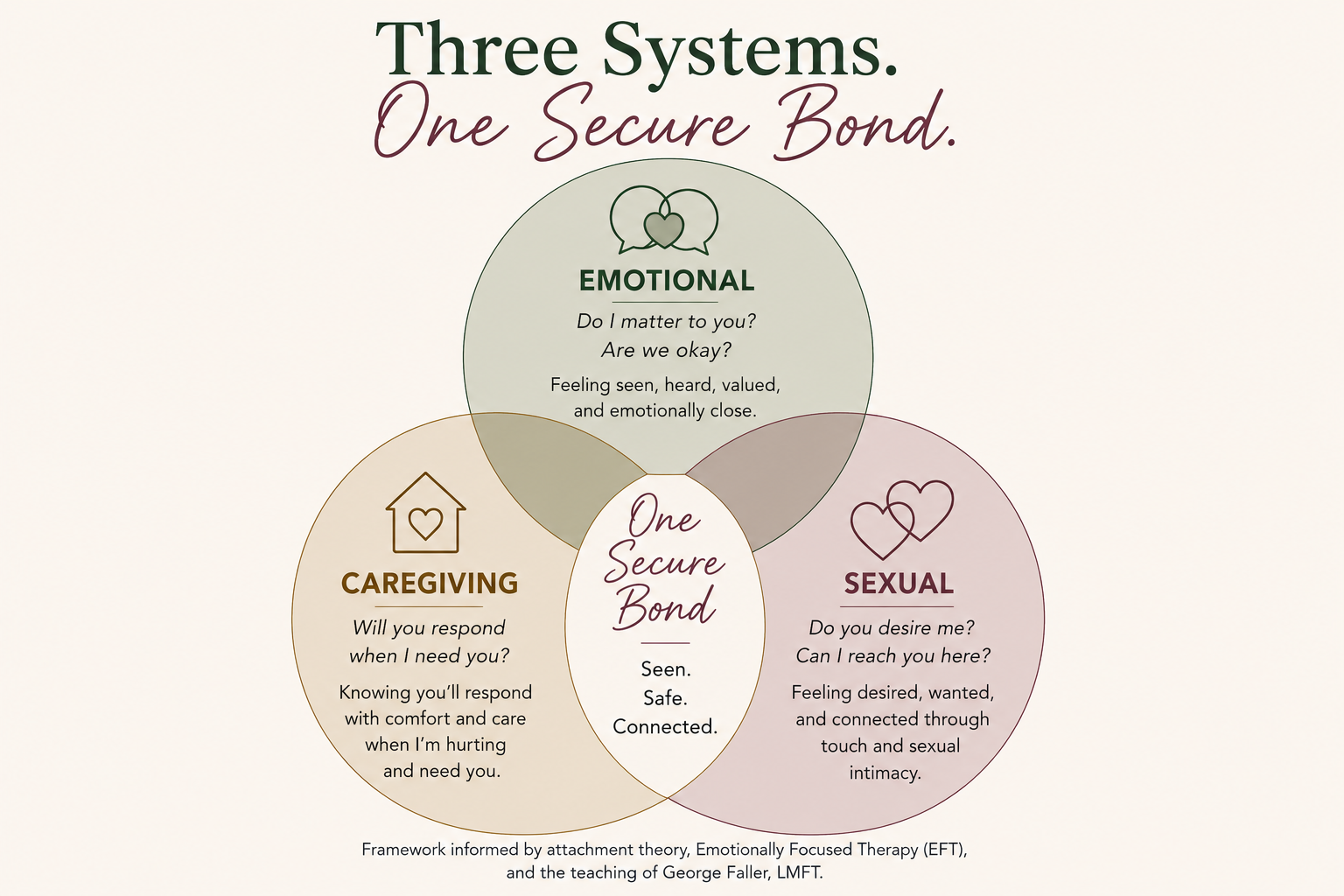
You're Both Reaching for Connection — Just in Different Ways
What helps you feel close may not be what helps your partner feel close.
For one of you, connection may come through talking, reassurance, and feeling emotionally understood. For the other, touch and sexual intimacy may be where you most deeply experience being wanted and chosen.
And sometimes the missing piece isn't emotional or sexual at all. It's knowing your partner will notice when you're struggling, respond when you need them, and help carry the weight of life with you.
These aren't separate parts of your relationship.
Emotional connection, caregiving, and sexual connection continually influence one another.
When one feels uncertain, the others can begin to shift, too.
So, What Do We Do With This?
We get curious about what sex, touch, closeness, and distance have come to mean between you.
Rather than focusing on how often you're having sex — or deciding who should want it more — we'll slow down the patterns surrounding intimacy and understand what happens for each of you when you reach, hesitate, pursue, pull away, or stop reaching altogether.
That might mean working through resentment that has made desire harder to access. Rebuilding emotional safety after betrayal. Understanding differences in desire without turning either partner into the problem. Or finding your way back to each other after years of being parents, professionals, household managers, and everything else life has asked you to be.
Sometimes the work begins with sex.
Sometimes sex is where we discover what else needs our attention.
The goal isn't simply more sex. It's creating a relationship where closeness, desire, and connection have room to find each other again.
Maybe This Looks Familiar
You don't have to be in a “sexless marriage” or relationship crisis for intimacy to feel like something is missing. Couples come to this work for all kinds of reasons, including:
You want sex at different frequencies — and the difference has become a source of hurt or conflict.
One of you initiates while the other increasingly avoids.
You miss affection, flirting, playfulness, or feeling desired by your partner.
Touch has started to feel loaded with expectation or pressure.
Sex has become routine, disconnected, awkward, or simply less important than it once felt.
Parenthood, stress, exhaustion, or resentment have changed your desire for one another.
Emotional closeness feels good, but your sexual connection has faded.
You're trying to rebuild emotional or sexual intimacy after betrayal or infidelity.
You've become great friends, parents, or teammates — but somewhere along the way, you stopped feeling like lovers.
You can be partners in life and still find your way back to being lovers.
Finding Your Way Back to Each Other
Intimacy doesn't have to look the way it did when you first met.
Relationships change. Bodies change. Parenthood changes us. Stress, loss, betrayal, aging, and simply living a life together can change how we experience desire and closeness.
The goal isn't to recreate an earlier version of your relationship.
It's to understand who you are now — what helps each of you feel safe, wanted, cared for, and connected — and begin creating an intimate relationship that fits the two people you've become.
There can still be curiosity. Playfulness. Touch. Desire. Vulnerability.
You can be partners in life and still find your way back to being lovers.
Ready to Feel Like Us Again?
You don't have to wait until intimacy disappears completely to start paying attention to what's happening between you.
I work with couples in Fort Mill, South Carolina and the greater Charlotte area, with virtual couples therapy available throughout South Carolina, North Carolina, and Florida.
If you love each other and want to understand what's gotten between you — emotionally, physically, or sexually — we can start there.